Word Solitaire: Associations
- 4.6
- Rating
- 500.00K
- Installs
- Free
- Price
 Analysis by App-foxy
I went into Word Solitaire: Associations expecting a familiar card game with a word-game layer attached, but its appeal is more specific than that. This is a free word game from NewPubCo that combines solitaire-style decision-making with matching ideas between words. That combination gives each short session a different rhythm from a standard crossword, an ordinary anagram game, or traditional Klondike solitaire.
The central attraction is the way a simple card-clearing structure makes word choices feel consequential. I am not only looking for a word that fits; I am also thinking about whether using it now helps open the board and preserve better options for later. That extra layer is what makes the game worth trying, especially if you enjoy quiet puzzles that reward patience rather than fast reflexes.
It is available at no upfront cost and is rated for Everyone, so it is easy to recommend as a casual family-friendly option. At the same time, the free-to-play model includes in-app purchases ranging from $1.99 to $119.99 per item, which is important to keep in mind before settling into long sessions. The current version is 1.5.1, and the game was released on October 27, 2025, so I see it as a relatively young product whose direction is still worth watching.
You May Also Like

 Blood Strike: 2.5 Anniversary
Blood Strike’s Loadouts Turn Every Drop Into a Tactical Gamble
A close look at Blood Strike’s custom loadouts: how fast access to signature weapons reshapes its battle royale rhythm, rewards preparation, and narrows the gap between fights.

 Pandora - Music & Podcasts
Pandora’s Music Is Easy to Start, but Harder to Recover
Pandora’s strength is its low-effort path from a seed to a station. Its weak spot is how much confidence it asks you to place in connection, setup, and quiet recovery.

 8 Ball Pool
 Is Built on Rivalries, Rematches, and Routine
A close look at the rivalries, rematches, shared routines, and unanswered safety questions that turn a quick pool match into a persistent mobile community.

 Samsung Music
’s Quiet Strength Is Playing What You Already Own
Its reach comes less from spectacle than from dependable access to a personal library. That simplicity is both the app’s strongest retention engine and its ceiling.

 AccuWeather: Weather Radar
AccuWeather Review: A Quick, Clear Forecast for Everyday Decisions
For everyday plans, the best forecast is the one you can understand quickly. AccuWeather makes rain timing, radar, and local conditions easy to act on, with a few trade-offs.

 Hill Climb Racing
Why Hill Climb Racing Still Turns Crashes Into One More Run
A tiny car, a bumpy hill and one more upgrade: Hill Climb Racing keeps resurfacing because its simple chaos makes every near-miss feel personal.
More From Our News Desk



How the current version feels to play
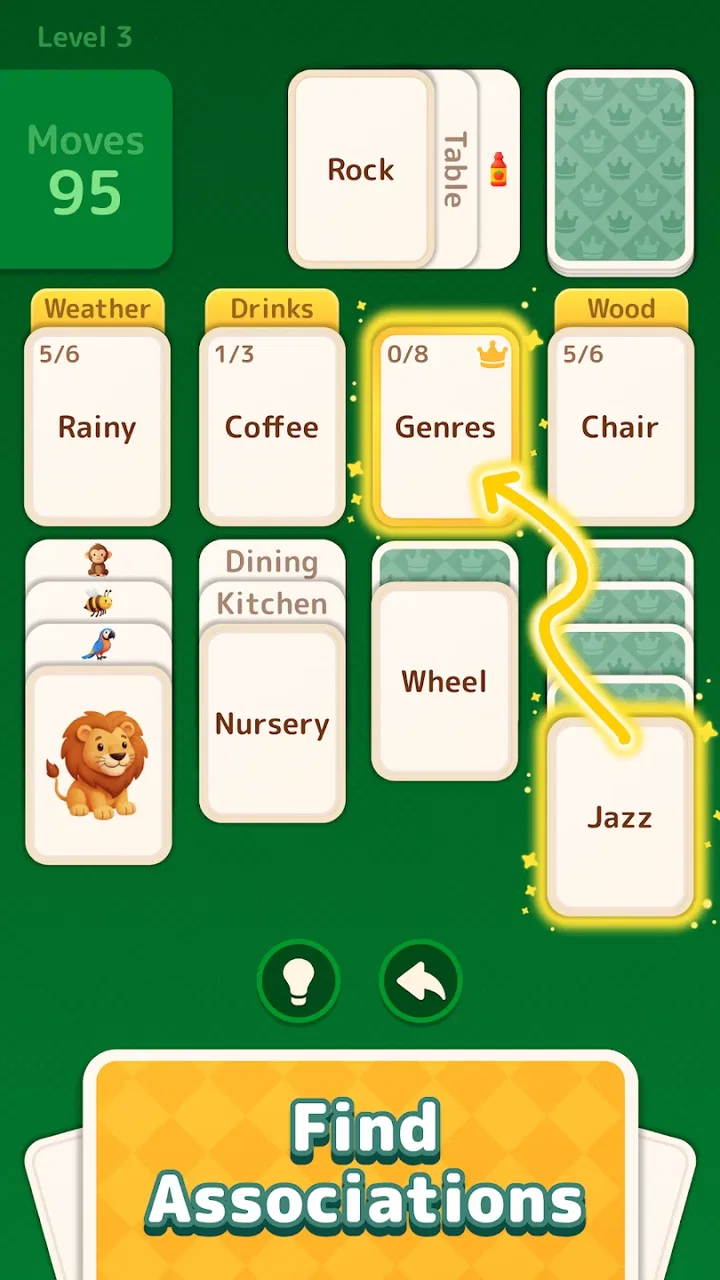
The best way to understand the game is to think of it as a conversation between two familiar puzzle habits. Solitaire encourages me to scan the layout, identify useful moves, and avoid spending a valuable card too early. Word matching asks me to notice relationships, associations, and possible connections between terms. Neither side completely disappears into the other, which is why the game feels more thoughtful than a basic word scramble.
My favorite sessions are the ones where the obvious match is not automatically the best move. A word may look attractive because it connects immediately, yet holding back can create a better route through the remaining layout. That makes the game suitable for players who enjoy planning several moves ahead without wanting the pressure of a timer or an action-heavy interface.
It also works well as a small break during an ordinary day. I can imagine opening it while waiting for an appointment, taking a few turns during a commute, or playing a quiet round before bed. The format does not demand the same sustained concentration as a long strategy game, but it still gives me something to think about. That balance is one of its strongest practical qualities.
New players should not approach it as a pure vocabulary test. Knowing more words can help, but recognizing useful relationships and managing the board matters just as much. Someone with a modest vocabulary may still enjoy it by learning the game’s patterns, while a very strong word-game player may need to adjust if they are used to solving each clue independently.
The strategic choice behind each match
The clever part is not simply finding an association. The more interesting question is when to use that association. I found it useful to separate two thoughts: first, whether a pair makes sense, and second, whether clearing it now improves the position. That small pause prevents the game from becoming a sequence of impulsive matches.
A practical habit is to scan the whole visible layout before committing to the first promising connection. Look for words that appear to unlock several possibilities, then compare them with words that are more isolated. Clearing an isolated option can reduce clutter, but spending a flexible word too early may leave fewer choices later. This is the kind of trade-off that a short store description would never explain, yet it quickly becomes central to playing well.
I also recommend treating uncertain associations as future possibilities rather than immediate targets. If a connection feels weak, forcing it can make the board harder to read. Waiting gives me time to see whether another route becomes available. That approach is especially useful for players who tend to chase every possible match as soon as they notice it.
Another helpful technique is to use the game as a vocabulary-learning exercise without turning it into homework. When a relationship feels unfamiliar, I try to remember the broader idea behind it instead of memorizing a single answer. Over time, that makes later puzzles feel less like guessing and more like recognizing a pattern. The result is a gentler learning curve than in games that rely entirely on obscure definitions.
Who will enjoy it most
This is a strong fit for people who like word puzzles with light strategy. It should appeal to a solitaire fan who wants more mental variety, a word-game player who wants a board-management element, or anyone who enjoys calm games that can be played in short bursts. It is also a reasonable choice for families looking for an Everyone-rated title that does not depend on combat, competition, or complicated controls.
I would be more cautious about recommending it to players who want a pure solitaire experience. If your ideal card game is about suits, ranks, and familiar probability decisions, the word-association layer may feel like an interruption rather than an improvement. Likewise, someone looking for a serious competitive word challenge may prefer a game built around head-to-head scoring, timed rounds, or a large dictionary-focused system.
It is not the best choice for people who dislike uncertainty in word puzzles. Associations can feel more interpretive than a spelling challenge with one clearly correct answer. That flexibility is part of the charm, but it can also create moments where I understand why two words might connect without feeling completely satisfied by the intended relationship.
What has changed and what the current release tells me
The current release, 1.5.1, suggests a product that has already moved beyond its earliest launch state, but I would not treat the version number as proof of a particular feature or redesign. What I can reasonably say is that the game is being maintained as an active product rather than sitting untouched after release. That matters for a new title because early updates often determine whether the basic idea becomes a polished long-term game.
For existing users, the practical takeaway is simple: the current version is the one to judge today, not an imagined future edition. If you tried it near launch and found the concept promising but rough around the edges, it is worth checking again rather than assuming the first impression is permanent. At the same time, I would keep expectations measured. A newer version number does not automatically mean that every personal annoyance has been addressed.
The game’s early audience is already meaningful. It has passed 500K installs and holds a 4.6 average from around 5.1K ratings, with roughly 344 written reviews. Those figures indicate that the concept has found a receptive audience, but they do not replace personal testing. A player who loves classic solitaire may react very differently from someone who normally chooses vocabulary games.
I find the release timing relevant because it frames the game as something still establishing its identity. The foundation is clear: solitaire structure plus word associations. The open question is how deeply NewPubCo will develop that foundation over time. Will future work focus on smoother onboarding, broader puzzle variety, better control over difficulty, or simply more content? Those are different paths, and each would change who benefits most from continuing to play.
The effect on players who already use it
For an existing player, the main benefit of staying with the game is familiarity. Once I understand how the word relationships interact with board decisions, I spend less time learning the rules and more time refining my choices. That is where the title becomes more rewarding: not because the basic action changes, but because I begin to notice when a convenient match is strategically poor.
Returning players should pay attention to whether the current release changes their daily routine in a useful way. If the game gives you a satisfying mental reset without taking over your schedule, it has found an effective niche. I would use it as a deliberate short-session game rather than an endless background activity. That keeps the word associations fresh and reduces the risk of playing mechanically.
The purchase structure may affect how comfortable long-term users feel. The game is free to start, but individual in-app purchases can cost from $1.99 to $119.99. I recommend deciding in advance whether you are happy to remain within the free experience or whether you would consider optional spending. Setting that boundary early is more sensible than making repeated small purchases simply because a difficult puzzle has become frustrating.
For parents or anyone sharing a device, the Everyone rating makes the age positioning straightforward, but I would still explain the purchase model before handing it over for unsupervised play. The rating describes suitability by age; it does not answer the separate question of how a household wants to manage optional spending.
Useful ways to fit it into daily life
One realistic scenario is a ten-minute waiting period. Instead of opening a social feed and losing track of time, I can play a few moves, inspect the available associations, and stop at a natural point. The game works particularly well here because it engages attention without requiring a long setup or a team.
A second use is as a gentle transition between demanding tasks. After writing, studying, or working through a detailed problem, a round gives my mind a different kind of focus. I am still making decisions, but the decisions are bounded and concrete. I would not call it a relaxation app, yet its slower puzzle rhythm can be more restorative than another competitive game.
A third use is shared solving. Two people can look at the same board and debate whether a connection is worth using immediately. That turns the game into a small conversation about language and strategy. It is not the same as multiplayer play, and I would not present it that way, but the design naturally supports informal collaboration when someone nearby is interested.
For better results, I suggest playing in two passes. On the first pass, inspect the board and mark mentally which words seem flexible. On the second, choose the move that improves access to the rest rather than the move that merely looks clever. This method reduces wasted opportunities and makes the solitaire side of the design much clearer.
Where the experience still has limits
The hybrid design can also be its biggest weakness. Players who want a clean, instantly readable puzzle may find the association element less precise than a conventional word search or crossword. When a relationship feels subjective, the satisfaction of solving can depend on accepting the game’s intended connection rather than proving an answer through spelling or definition alone.
There is also a potential repetition problem. The core loop is appealing, but its long-term freshness depends on how much variety the puzzle design can provide. If you play for extended periods every day, the familiar sequence of scanning, matching, and clearing may begin to feel routine. I get more enjoyment by alternating it with other games instead of expecting it to be my only word title.
The free-to-play structure deserves careful attention as well. Even when the basic game is enjoyable without spending, the presence of purchases from $1.99 to $119.99 means the overall experience may not suit readers who want a completely purchase-free environment. I would especially avoid recommending it to anyone who finds optional offers distracting or who prefers to pay once and own the full experience.
Finally, the game is not a substitute for a robust dictionary tool or a serious language-learning course. It may encourage curiosity about word relationships, but its purpose is entertainment first. If your priority is systematic vocabulary study, grammar practice, or measurable language progress, a dedicated educational app would be a better companion.
What I would watch next
As the game develops, I would watch for improvements that make the association logic easier to understand without removing its challenge. Clearer explanations around difficult connections could help new players while preserving the strategic layer for experienced users. I would also value more ways to distinguish a genuinely strong move from a merely valid one.
Difficulty control is another area that could influence its future. Beginners need room to learn how word relationships and board management work together, while experienced players need reasons to keep returning after mastering the basic rhythm. Whether that comes through puzzle variety, more demanding layouts, or another approach, the balance will matter more than simply adding quantity.
I would also pay attention to how NewPubCo handles the relationship between free play and purchases. A fair experience should let players understand the game’s value before asking them to spend, and it should avoid making a difficult association feel like a reason to buy assistance. That is not a judgment that the current version fails; it is the standard I would use when evaluating future updates.
For people who already enjoy the game, the most useful sign will be whether later releases deepen the original idea instead of drifting away from it. The combination of solitaire planning and word matching is distinctive enough to support a focused identity. More polish, thoughtful puzzle construction, and a comfortable progression would strengthen that identity far more than unnecessary complexity.
My recommendation after playing
Word Solitaire: Associations is worth trying if you want a free, Everyone-rated word game that asks you to think about both language and timing. I like that it does not reduce the experience to spotting a connection; the better move often depends on what that connection does to the rest of the board. That gives the game a quiet strategic personality.
I would recommend it first to casual puzzle players, solitaire fans who want a change of pace, and anyone looking for a thoughtful title for short breaks. I would skip it if you need a pure card game, a competitive word arena, or a fully fixed-price experience with no optional purchase considerations.
NewPubCo has a promising idea here, and version 1.5.1 gives the game a reasonable point at which to evaluate it. My advice is to play slowly at first, resist using every obvious match immediately, and decide your spending limit before you begin. If you enjoy discovering why one word connection is strategically better than another, this unusual blend can become a satisfying part of your casual game rotation.
FAQs for Word Solitaire: Associations
01What is Word Solitaire: Associations?
Word Solitaire: Associations is a unique mobile game that combines the classic card game solitaire with word puzzle elements. Players must create words from given letters while strategically placing cards in the correct order to advance through levels. It's available for both Android and iOS devices.
02How do I play Word Solitaire: Associations?
In Word Solitaire: Associations, you arrange cards containing letters to form words. Each level has specific objectives, such as forming a certain number of words or reaching a target score. The game requires both strategic card placement and vocabulary skills to progress successfully.
03Is Word Solitaire: Associations free to play?
Yes, Word Solitaire: Associations is free to download and play. However, it offers in-app purchases that allow players to buy hints, extra moves, or remove ads. These purchases are optional and not necessary to enjoy the core gameplay experience.
04What are some tips for progressing in Word Solitaire: Associations?
To excel in Word Solitaire: Associations, focus on building longer words for higher scores, use hints sparingly to conserve resources, and plan your moves strategically to avoid getting stuck. Regularly practicing and expanding your vocabulary will also enhance your gameplay.
05Can I play Word Solitaire: Associations offline?
Word Solitaire: Associations requires an internet connection to download and update the game. However, once installed, you can play without an internet connection, making it a great option for on-the-go gaming without consuming data.
Pros
- Engaging word puzzles keep the mind sharp.
- Visually pleasing interface enhances gameplay.
- Offers daily challenges for consistent fun.
- No intrusive ads interrupting gameplay.
- Small app size
- doesn't consume much storage.
Cons
- Limited hints can frustrate beginners.
- Requires internet for some features.
- Progress sync issues across devices.
- Occasional lag on older devices.
- No multiplayer mode for social play.

Word Solitaire: Associations
Gallery